An enquiry creates an opportunity only when the business can respond usefully. Forms, inboxes and CRM notifications can all appear to work while leads remain unassigned, unanswered or difficult to track. The customer experiences the gap as silence or an irrelevant response.
A reliable follow-up process needs clear ownership, a small set of statuses and a visible next action. Establish those basics before adding automation.
Map how an enquiry reaches the team
List the entry points: website forms, calls, WhatsApp, social messages and advertising lead forms. Identify where each arrives and who checks it. Test the delivery rather than assuming a notification proves that a usable record has been created.
Keep enough context to explain the customer’s request. Capture the relevant service, message and contact details. Preserve campaign or page context when your measurement setup supports it and your data arrangements permit it. The first responder should not have to reconstruct the enquiry from several systems.
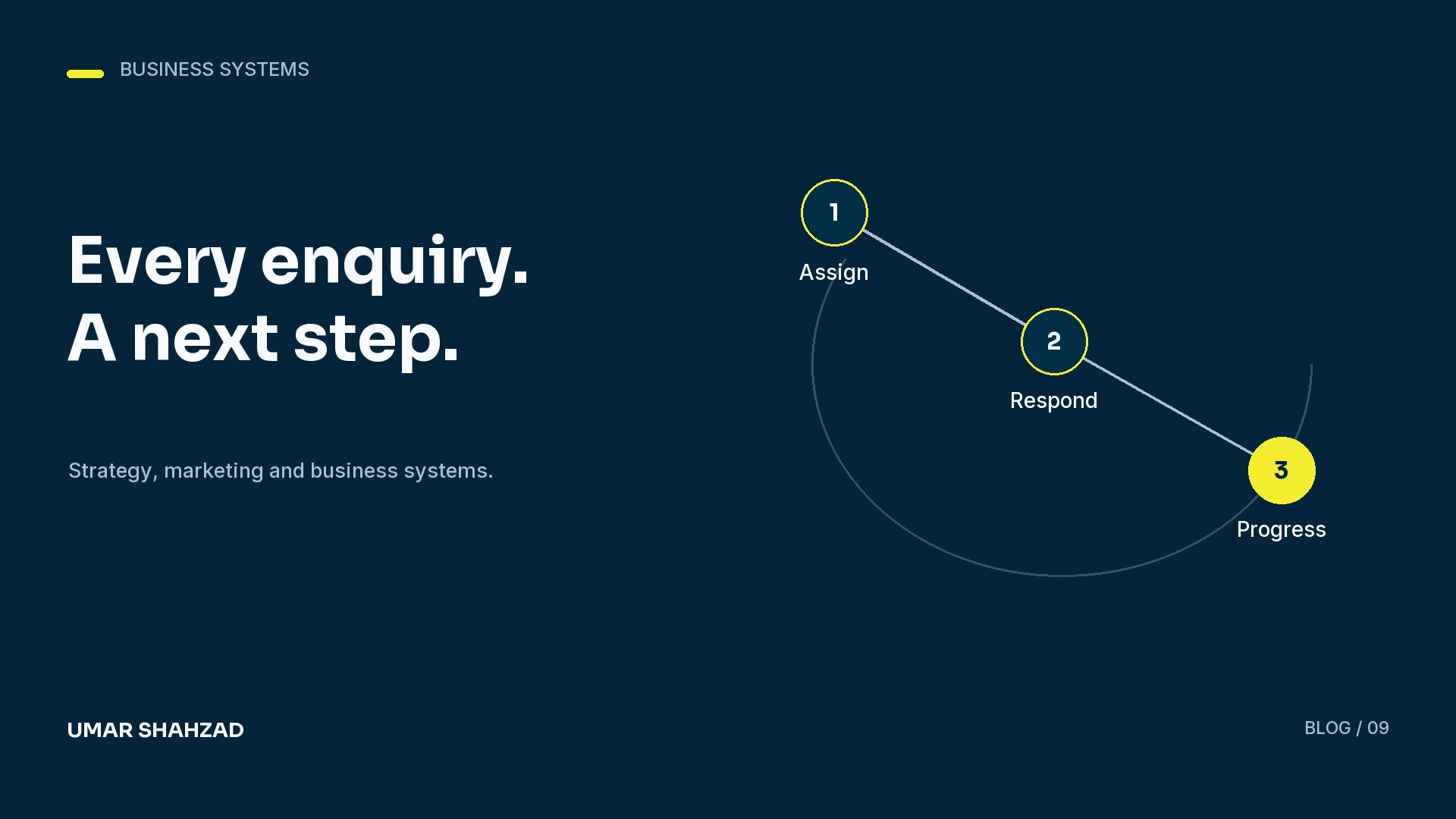
Assign an owner and a next action
Every new enquiry should have a responsible person or a defined assignment rule. Agree how quickly the team aims to make its first response based on staffing, opening hours and customer expectations. Make exceptions visible rather than letting them disappear into an inbox.
After each conversation, record the next action and due date. A status such as “contacted” says little about whether the customer needs a proposal, a consultation or another call. The next action keeps the work moving.
Keep qualification consistent
Use a short set of criteria for relevance: service requirement, location, timing and other essential conditions. Record an understandable reason when the enquiry is unsuitable. This gives marketing useful feedback and helps the team improve the offer or targeting.
Avoid a large status menu that each colleague interprets differently. A practical sequence might be new, response due, in discussion, suitable opportunity, proposal, won and closed. Adapt the sequence to the actual sales process and define when a record moves between stages.
Automate reminders after the process is stable
Useful automation can assign routine enquiries, acknowledge receipt and remind an owner about an overdue action. It should also handle failures: missing contact information, an unassigned record or a message that could not be delivered.
An acknowledgement is not a personalised response. Make the difference clear to the team. Keep customer-facing language accurate about what happens next, and avoid promising a response time the operation cannot consistently meet.
Review the operation alongside acquisition
Track new enquiries, suitable opportunities, first-response time and overdue actions. Review these with the campaign figures over a consistent period. A change in lead quality may reflect targeting, the offer, incomplete information or the way the team handles the response.
The Miami’s Best Blinds project connected advertising, conversion measurement and CRM follow-up. The value of that connection is a more visible route from interest to a business conversation.
Give the team a process they can maintain
Document the workflow on one page, train the people using it and assign someone to review it regularly. Remove steps that do not help the customer or the team. A process that depends on one person remembering everything will become fragile as volume grows.
For the measurement setup, read why campaign and CRM counts differ. For assisted administration, see where AI can help a growth team.