Quick answer: Start with accurate conversion tracking, a way to record lead quality and customer outcomes, and a simple reporting routine. Add paid PPC management tools when they solve a specific monitoring, testing or workload problem.
A 2027 planning guide, researched in October 2026. Recommendations reflect tool capabilities available at research time; they are not a prediction of future features or a hands-on performance benchmark.
Your PPC dashboard says you're winning. Your bank account might disagree.
Imagine you have a 6% conversion rate. Your cost per lead is dropping. Google Ads is showing green arrows everywhere.
Sounds like a successful campaign, right?
But then you ask the sales team how many customers those leads actually produced.
Suddenly, things look different.
This is one of the biggest problems with PPC management: we've become incredibly good at measuring advertising activity, but not always at measuring business success.
And buying another expensive PPC tool won't automatically fix that.
As someone who works across paid advertising, websites, conversion tracking, and digital growth strategy, I believe the most useful PPC tools are the ones that help connect the entire customer journey.
Not just the click.
Not just the form submission.
But what happens next.
In this guide, I'll walk through the PPC management tools worth considering for 2027, explain when you actually need them, and show how to combine them into a practical system.
Why cost per lead can hide the real outcome
Imagine you're running two Google Ads campaigns for a service business.
Illustrative example—not actual client results.
| Metric | Campaign A | Campaign B |
|---|---|---|
| Advertising spend | $2,000 | $1,800 |
| Leads | 100 | 60 |
| Cost per lead | $20 | $30 |
| Customers won | 6 | 12 |
| Advertising spend per customer | $333.33 | $150 |
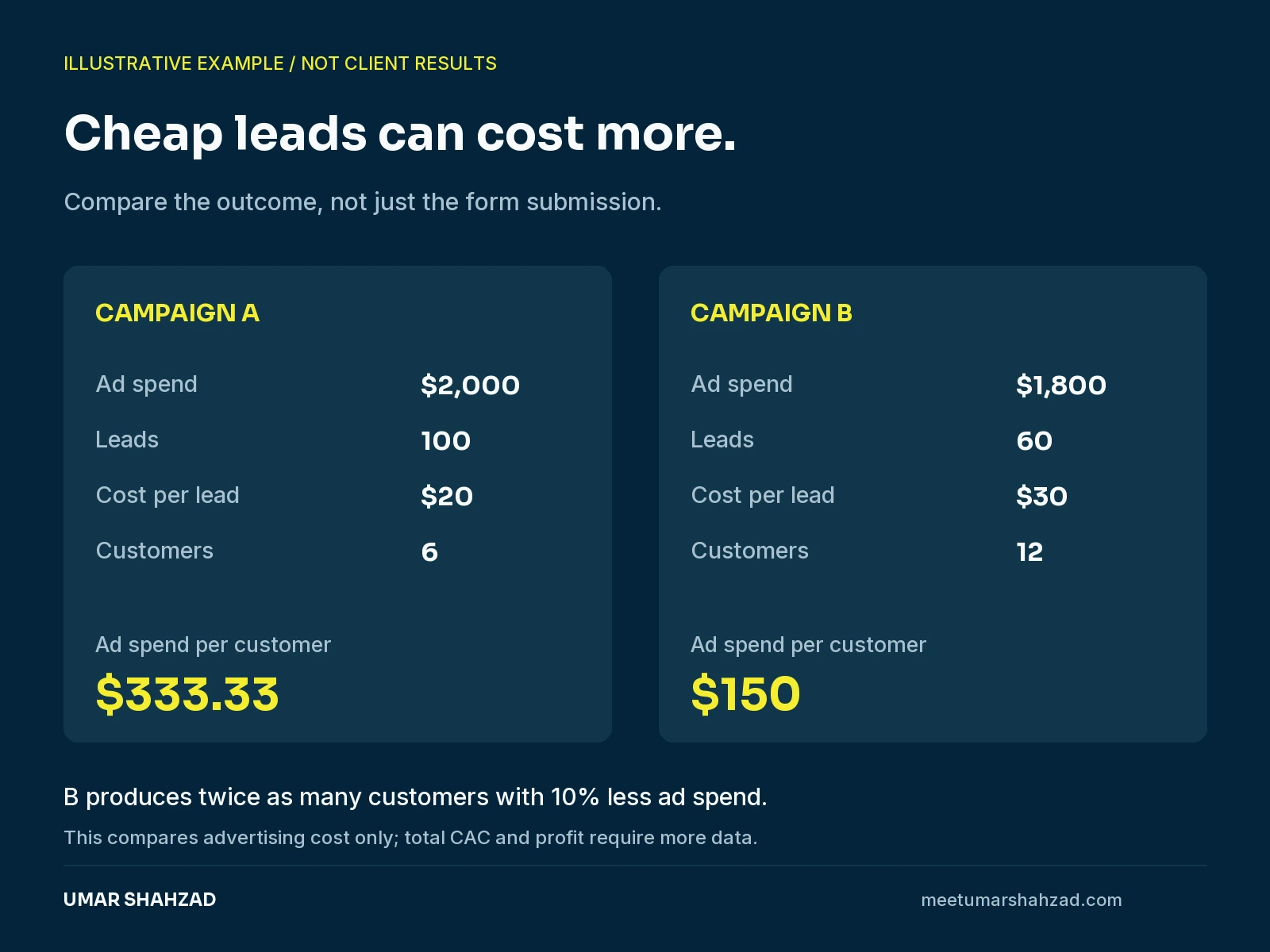
Compare equivalent cohorts after allowing enough time for sales to close. Campaign B produces twice the customers with 10% less ad spend in this example. Advertising spend per customer excludes sales labour, software and other acquisition costs; it is not full customer acquisition cost (CAC). Check customer value, margin and capacity before moving budget.
If you were optimizing purely for cost per lead, Campaign A would look better.
But Campaign B generated twice as many customers with less advertising spend.
That's a completely different story.
Now imagine your PPC tools only report leads. You might increase Campaign A's budget and reduce Campaign B's.
Congratulations. You've just optimized away from the better business outcome.
This is why I prioritize measurement, lead quality, and business outcomes before sophisticated PPC automation.
What a useful PPC stack should answer
A strong PPC setup doesn't require every tool on the market.
It needs to answer five questions:
- Can I trust the conversion data?
- Which campaigns bring qualified leads and customers?
- Where am I wasting advertising budget?
- What prevents visitors from converting?
- What should I change next?
Here's how I would structure a practical PPC stack.
You don't need all of these on day one. The right combination depends on how your business generates leads, how much you spend, and how complex your campaigns have become.
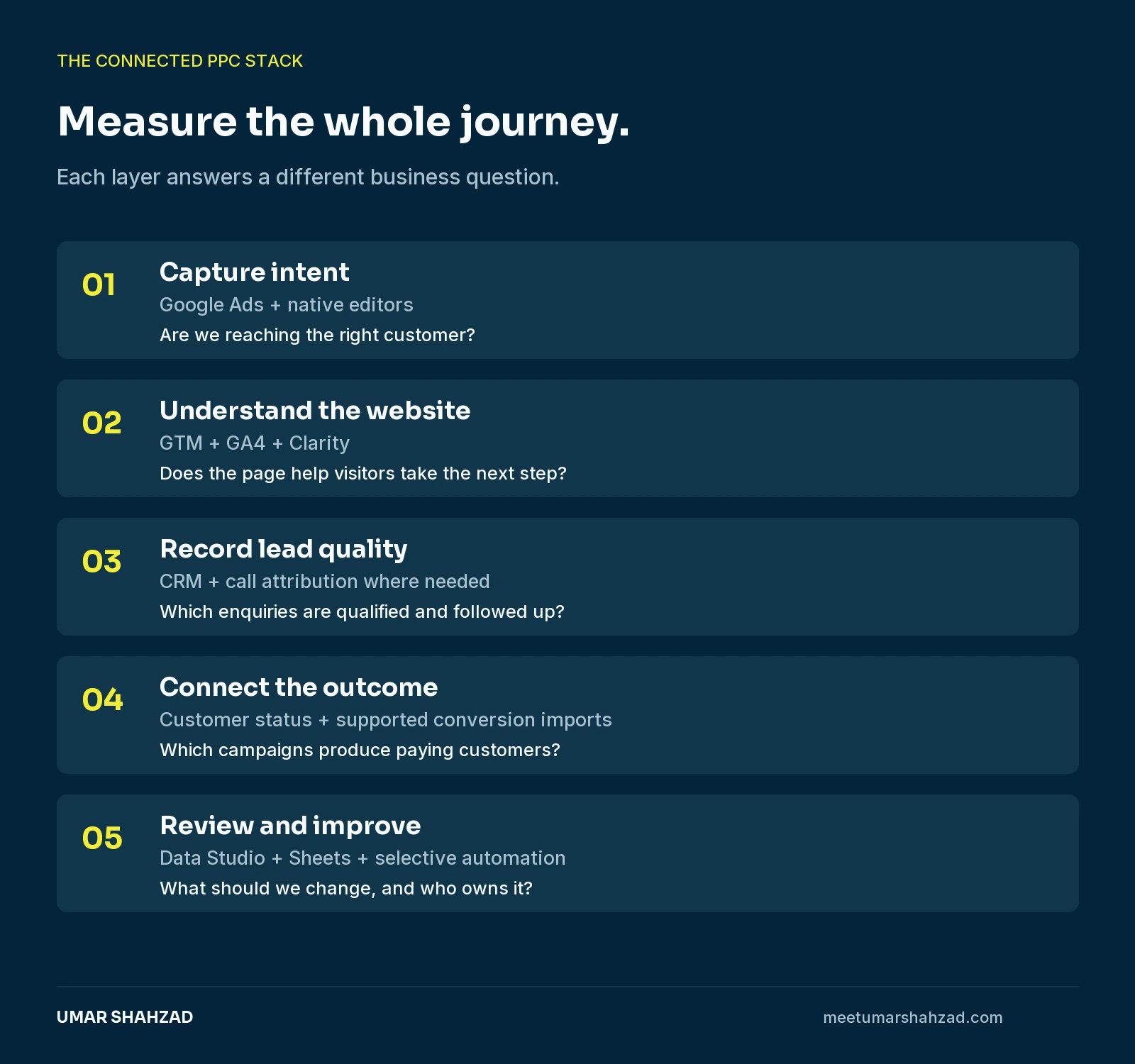
11 PPC management tools and where they fit
| Tool | Primary job | Cost model | Use it when |
|---|---|---|---|
| Google Tag Manager | Tracking implementation | Free standard tool | Before scaling spend |
| Google Analytics 4 | Website journeys and key events | Free standard version | To investigate visitor behaviour |
| HubSpot CRM | Lead status and sales outcomes | Free entry tier; paid plans | When leads need follow-up |
| CallRail | Phone attribution | Paid; market availability varies | When calls drive sales |
| Google / Microsoft Ads Editors | Bulk campaign changes | Free native tools | When browser edits become slow |
| Google Sheets | Decision logs and simple analysis | Free personal use; business plans vary | From the first review |
| Microsoft Clarity | Heatmaps and session recordings | Free | When landing pages underperform |
| Optmyzr | Monitoring and account workflows | Paid | When account complexity justifies it |
| Adalysis | Account audits and testing workflows | Paid | When structured testing needs support |
| Google Data Studio | Shareable reporting | No-cost version; Pro paid | When stakeholders need one view |
| AI assistants | Analysis and drafting support | Free and paid plans vary | With verified data and human review |
1. Google Tag Manager
Best for: Managing marketing tags and conversion events.
Cost: Free.
If I had to identify the most important part of a PPC setup, it wouldn't be a premium optimization tool.
It would be reliable conversion tracking.
Google Tag Manager (GTM) helps manage tracking tags without requiring a separate website code deployment for every marketing event.
You can use it to implement and manage Google Ads conversion tags, GA4 events, and other measurement integrations.
But GTM is not a set-it-and-forget-it solution. An incorrect trigger or duplicate tag can create misleading conversion counts.
For example, imagine a contact form sends a conversion every time someone clicks Submit—even when the form fails validation.
Your advertising platform might report successful leads that never actually existed.
My recommendation: Before optimizing bids, verify that important conversion events fire correctly, exactly when intended, and with appropriate deduplication.
2. Google Analytics 4
Best for: Website behavior, acquisition analysis, and conversion journeys.
Cost: Free standard version.
Google Ads tells you a lot about your advertising performance.
Google Analytics 4 (GA4) helps you understand what visitors do on your website.
Did paid visitors engage with the landing page? Did they reach the contact form? Which pages are involved in the conversion journey?
For most businesses, I'd focus on a few meaningful indicators rather than building dashboards around dozens of metrics.
- Landing page engagement
- Key events and conversion paths
- Traffic source and campaign performance
- Device-level behavior
- Drop-offs between important actions
One important distinction: Google Analytics uses key events to identify important user actions, while Google Ads conversions are used for campaign measurement and optimization.
Don't assume the numbers across both platforms will always be identical. Understand differences in attribution, configuration, and reporting before drawing conclusions.
My recommendation: Use GA4 to investigate the customer journey, not as a replacement for correctly configured Google Ads conversion measurement.
3. HubSpot CRM
Best for: Lead qualification, sales pipeline visibility, and customer tracking.
Cost: Free entry-level CRM, with paid options.
This is where I think many PPC tool recommendations miss an important opportunity.
An advertising campaign doesn't end when someone submits a contact form.
That lead still needs to be contacted, qualified, quoted, and converted into a customer.
A CRM helps record this process.
HubSpot is one option, but the underlying principle applies whether you use HubSpot, another CRM, or a properly maintained lead management system.
Consider a simple sales pipeline:
New Lead → Contacted → Qualified → Proposal Sent → Won / Lost
Now add the original advertising source.
You can begin answering a much more valuable question:
Which campaigns are producing leads that actually become customers?
For more advanced setups, qualified-lead and sales outcomes can also be connected back to Google Ads using supported conversion import methods, including enhanced conversions for leads.
My recommendation: If you're running lead-generation campaigns, invest in lead-status tracking before adding another optimization subscription.
4. CallRail
Check market coverage first: CallRail lists support for the United States, Canada, Australia and the United Kingdom. Businesses in Pakistan or the UAE should verify availability or choose a suitable local alternative before building their stack around it.
Best for: Call-driven service businesses.
Cost: Paid.
Not every customer prefers a form.
For dentists, contractors, home service businesses, legal firms, and other local service providers, telephone enquiries can be a significant part of the customer journey.
CallRail provides call tracking and integrates with Google Ads.
This can help advertisers understand which campaigns generate calls rather than relying entirely on form submissions.
However, call tracking isn't necessary for every business, and availability, coverage, and suitability should be checked for the country where you operate.
My recommendation: Consider dedicated call attribution when phone enquiries represent meaningful revenue and your existing tracking cannot explain where those calls originate.
5. Google Ads Editor and Microsoft Advertising Editor
Best for: Bulk campaign creation, editing, and management.
Cost: Free.
Some PPC tools earn their place in your workflow simply because they eliminate repetitive work.
Google Ads Editor is a good example.
Instead of updating campaigns one by one in the browser, you can download your account, work on changes offline, review them, and upload them.
It's particularly useful for:
- Building large campaign structures
- Editing multiple ads or keywords
- Updating landing page URLs
- Reorganizing ad groups
- Importing or exporting campaign elements
Microsoft Advertising also offers its own native Editor application.
A word of caution: efficiency doesn't remove the need for quality control. Bulk mistakes can be just as efficient as bulk improvements.
My recommendation: Use native editors before paying for software solely to simplify bulk campaign management.
6. Google Sheets
Best for: Planning, budget pacing, approvals, and collaboration.
Cost: Available free; business plans and some integrations may cost extra.
I like tools that make processes easier to understand.
And despite all the sophisticated platforms available, a well-structured spreadsheet remains useful.
You can build campaign plans, review search terms, map keywords to landing pages, track budgets, and document changes.
For a small business or growing agency, a shared Sheet can also become a central place for decisions and approvals.
The important part isn't the spreadsheet itself.
It's the process behind it.
For example, a search term review becomes more productive when the document identifies the search term, campaign, cost, recommendation, reviewer, and final action.
My recommendation: Don't buy specialized software to solve a process you haven't clearly defined yet.
7. Microsoft Clarity
Best for: Landing page behavior and conversion rate optimization.
Cost: Free.
This is one of the tools I'd include in a PPC stack even though it isn't strictly a PPC management platform.
Why?
Because your advertising performance depends on what happens after people arrive on the website.
Microsoft Clarity offers heatmaps and session recordings that help you investigate visitor behavior.
You might discover that users repeatedly click something that isn't interactive, struggle with a form, or never reach an important call to action.
Those observations can guide website improvements.
For example, imagine a landing page with strong ad relevance and plenty of traffic but very few enquiries.
The natural reaction might be to change bidding strategies or rewrite ads.
But if visitors encounter friction on the landing page, changing bids won't resolve the underlying problem.
Use Clarity alongside quantitative data and configure it with appropriate privacy and consent safeguards.
My recommendation: Before increasing advertising spend, investigate whether your landing page is turning away potential customers.
8. Optmyzr
Best for: PPC managers and agencies handling more complex accounts.
Cost: Paid.
Once campaign volume and account complexity increase, repeated checks become harder to manage manually.
Optmyzr offers tools for account monitoring, automated rules, budget management, reporting, and optimization workflows.
Its appeal isn't simply that it offers automation.
It's that automation can help surface potential problems and reduce repetitive account management.
For example, rules and alerts may help identify budget pacing issues, performance anomalies, or areas requiring attention.
But automated recommendations still require context.
A campaign with an unusually high cost per conversion isn't necessarily a bad campaign if those conversions represent more valuable customers.
My recommendation: Explore Optmyzr when the time saved and the problems identified are valuable enough to justify the subscription.
9. Adalysis
Best for: PPC testing, monitoring, and optimization.
Cost: Paid.
Almost every PPC marketer agrees that testing is important.
The challenge is testing consistently.
Adalysis focuses on PPC analysis, monitoring, and testing workflows.
It can help advertisers identify account issues and evaluate optimization opportunities without relying on an entirely manual process.
Where this becomes useful is consistency.
Rather than making ad changes based on instinct, you establish a repeatable process for reviewing evidence and deciding what deserves attention.
Still, no tool can tell you whether a statistical improvement matters commercially without the right business context.
My recommendation: Consider Adalysis when testing and routine monitoring have become operational bottlenecks. Compare its capabilities with existing tools before paying for overlapping features.
10. Google Data Studio
Best for: Dashboards, stakeholder reporting, and performance visibility.
Cost: Free standard version; paid Pro edition.
Google's reporting product formerly known as Looker Studio returned to the name Data Studio in April 2026.
Whatever name you remember, the important feature is the ability to create shareable reports and dashboards.
For PPC reporting, I would rather see a small number of meaningful business metrics than an impressive-looking dashboard filled with irrelevant charts.
A practical lead-generation report might contain:
- Advertising spend
- Tracked leads
- Cost per lead
- Qualified leads
- Customers acquired
- Ad spend per acquired customer
- Revenue and return metrics, where reliable data is available
Some of these require CRM data and appropriate integrations; they aren't all available directly from Google Ads.
A report should make the next decision easier.
My recommendation: Build dashboards around the questions a business owner actually needs answered.
11. AI tools for PPC management
Best for: Analysis support, planning, documentation, brainstorming, and workflow development.
Cost: Free and paid options vary.
AI can be valuable in PPC management.
But there's a significant difference between asking AI to help analyze a campaign and letting it change live advertising settings without review.
I see stronger opportunities in tasks such as:
- Reviewing anonymized search term data for patterns
- Developing alternative advertising messages
- Analyzing performance changes
- Organizing campaign structures
- Building reporting templates
- Drafting testing hypotheses
- Producing client-friendly explanations
For example, instead of asking AI to improve my Google Ads, try a more specific request:
“Review this anonymized search term report. Group queries by buying intent, identify potential irrelevant themes, explain where wasted spend may exist, and recommend questions I should investigate before making changes.”
That's a much more useful starting point.
AI can produce incorrect interpretations, so calculations and recommendations should be verified. Never upload confidential customer information or account data without the appropriate authorization and safeguards.
My recommendation: Use AI to improve the speed and quality of your thinking. Keep a human responsible for account strategy, approvals, and changes.
Choose a PPC stack around your business
Let's make this practical.
Different businesses need different levels of sophistication.
These are starting points, not fixed requirements.
| Business situation | Start with | Add when needed |
|---|---|---|
| Small service business | GTM, GA4, native Ads tools, CRM or structured lead log | Clarity for page diagnosis; reporting when reviews become repetitive |
| Phone-led business | Reliable call attribution plus lead status and customer tracking | A call-tracking provider that supports your country and integrations |
| Agency or several complex accounts | Shared measurement standards, CRM outcomes, native editors and reporting | Optmyzr or Adalysis when saved work and improved oversight justify the cost |
| Ecommerce business | Validated purchase events, revenue, product margin and returns visibility | More sophisticated reporting or automation when catalogue and budget complexity demand it |
A business spending modestly on advertising may be better off fixing its tracking and landing pages than investing in expensive management software.
An agency overseeing numerous campaigns might justify a premium tool because it reduces manual monitoring and improves consistency.
The decision should come from the problem you need to solve—not the popularity of the software.
Build a weekly PPC review routine
Whether you manage one campaign or multiple accounts, I recommend establishing a routine before introducing more automation.
Here's a simple weekly review structure.
| Review | Evidence to inspect | Decision to record |
|---|---|---|
| Measurement health | Test submissions, duplicate events, CRM capture and imports | Fix failed or misleading conversion signals before optimisation |
| Spend and intent | Budget pacing, search terms and campaign segmentation | Investigate irrelevant intent and explain any proposed budget change |
| Lead quality | Qualified leads, won customers and lost reasons by campaign | Change targeting only after allowing for sales lag and sample size |
| Landing page friction | Device performance, form errors, recordings and sales feedback | Choose one specific page or form improvement to test |
| Experiment and follow-up | Previous changes, outcome trends and outstanding sales tasks | Keep, reverse or continue a test; assign an owner and review date |
Decision-log template: Date → problem → evidence → proposed change → owner → expected outcome → review date. For example: mobile form abandonment increased after a site update; reproduce the error, repair the form, then verify successful submissions and lead quality.
Small samples and delayed sales can make a week look misleading. Avoid changing bids, targeting and landing pages together if you want to understand which change caused the result.
This is a starting framework, not a substitute for account monitoring or deeper analysis.
High-spend or high-risk campaigns may require more frequent attention.
The real benefit is that every review ends with a documented decision, rather than another hour of browsing performance dashboards.
Common PPC tool mistakes to avoid
If your conversion data is incorrect, automated decisions can make the situation worse.
Get the measurement foundation right first.
If you already have effective reporting, alerts, and monitoring, don't automatically purchase another platform offering the same features.
Evaluate the additional value.
The lowest cost per lead isn't necessarily the lowest cost per customer.
When possible, connect advertising performance to qualified leads, sales, and revenue.
AI can be a powerful assistant, but it doesn't automatically understand business margins, operational constraints, customer quality, or campaign history.
Verify its conclusions before acting.
Connect the first click to the paying customer
Tools can automate repetitive work.
They can make reports more accessible, highlight unusual performance, and reduce manual effort.
But they cannot independently define what success means for your business.
A strong PPC strategy requires an understanding of your customers, offer, website, sales process, economics, and growth priorities.
That's why I prefer to think of PPC as part of a connected customer acquisition system rather than an isolated advertising channel.
The real opportunity isn't just improving campaign performance.
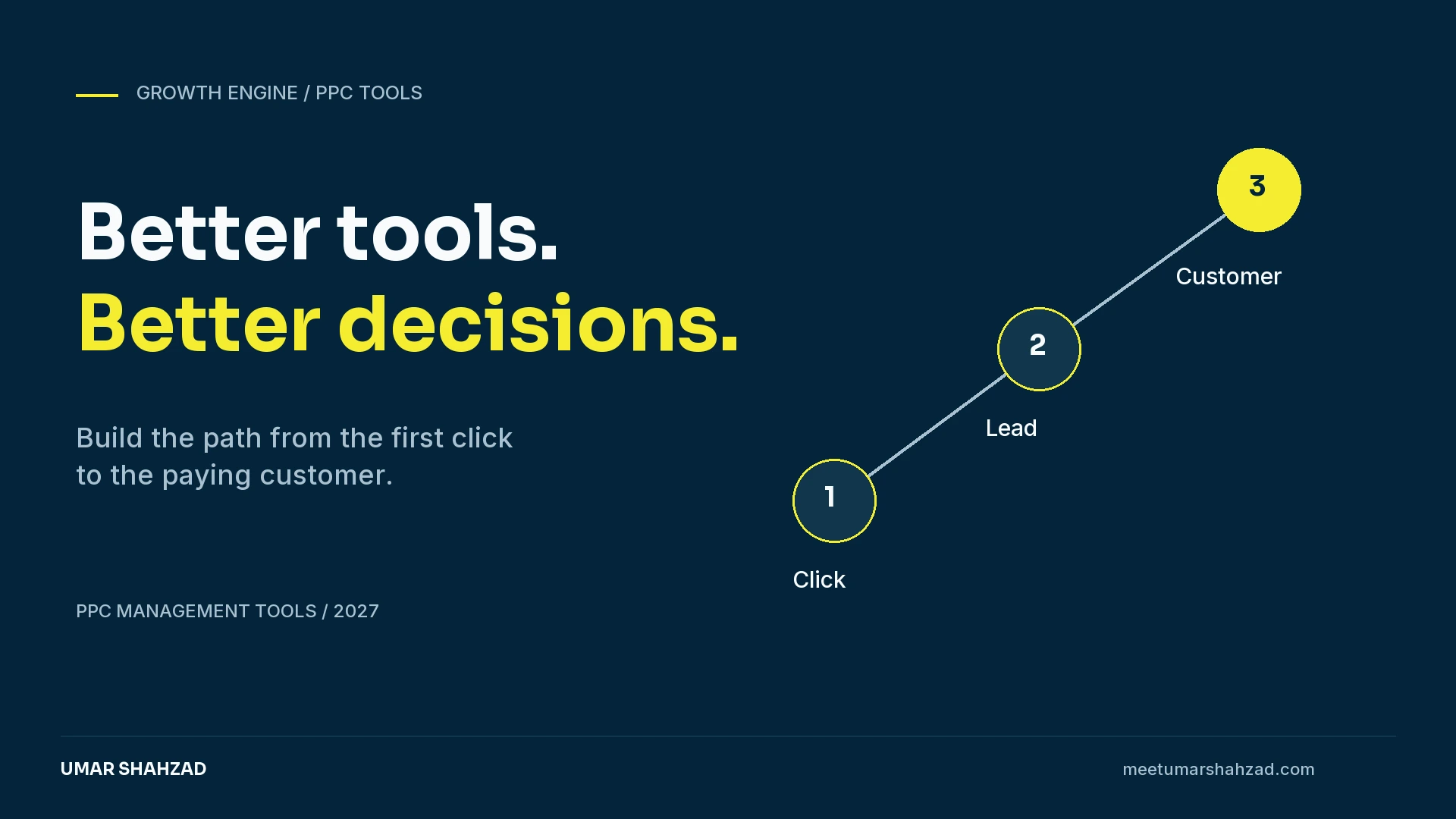
It's improving the path from the first click to the paying customer.
And sometimes the highest-impact improvement isn't inside Google Ads at all.
It might be a better landing page.
A faster sales response.
A properly configured conversion event.
Or finally tracking which leads become customers.
The best PPC management tool isn't the one with the most features. It's the one that helps you make a better business decision.
Frequently asked questions
What are the best free PPC management tools?
Google Ads Editor, Google Tag Manager, Google Analytics 4, Google Sheets, Microsoft Clarity, and the standard version of Google Data Studio are useful options. Their combined value depends on implementation, reporting needs, and workflow.
Is Optmyzr worth paying for?
It can be valuable for advertisers and agencies that need additional monitoring, budget oversight, automation, and account management capabilities. Evaluate the cost against the time and value it adds to your existing workflow.
Can AI manage PPC campaigns automatically?
AI-powered systems can support campaign management and automation, but they still require reliable data, suitable controls, and human oversight. Fully unattended account changes can introduce unnecessary risk.
Do small businesses need paid PPC tools?
Not necessarily. Many small businesses can establish effective measurement, campaign execution, and reporting using native advertising tools and free analytics solutions. Paid tools become more useful as complexity grows.
Which PPC metrics matter most?
There is no universal answer. For ecommerce, revenue and profitability metrics may be central. For lead-generation businesses, qualified leads, customers acquired, and acquisition economics may provide a better picture than raw lead volume alone.
Need help connecting PPC to business results?
I work with businesses on the complete customer acquisition journey—from conversion-focused websites and advertising campaigns to tracking, optimization, and lead generation.
If your campaigns are generating clicks but you're struggling to connect them to business results, the first step is to identify where the customer journey is breaking down.
Explore my work and get in touch at Discuss your PPC and measurement setup.
Related reading: Diagnosing Google Ads lead quality and Why campaign and CRM reports disagree.
Product reference: Google’s April 2026 Data Studio naming announcement. Tool plans and availability can change; this 2027 planning guide was prepared in October 2026.
Product references and research notes
Official references: HubSpot CRM plans, Microsoft Clarity pricing, Optmyzr capabilities, Adalysis plans and Google Data Studio documentation. Prices, plan limits and availability change. Evaluate these tools against your own workflow, data quality and commercial goals.